

Cartesia Review (2026)
Real-time voice for builders — fast beyond reason
Top5Apps editorial · Last tested & updated October 6, 2026 · Reviewed under The Receipts Standard
Developer
Cartesia
Free tier
Yes — monthly credits
Paid from
$5/mo
Platforms
API, Web playground
What is Cartesia?
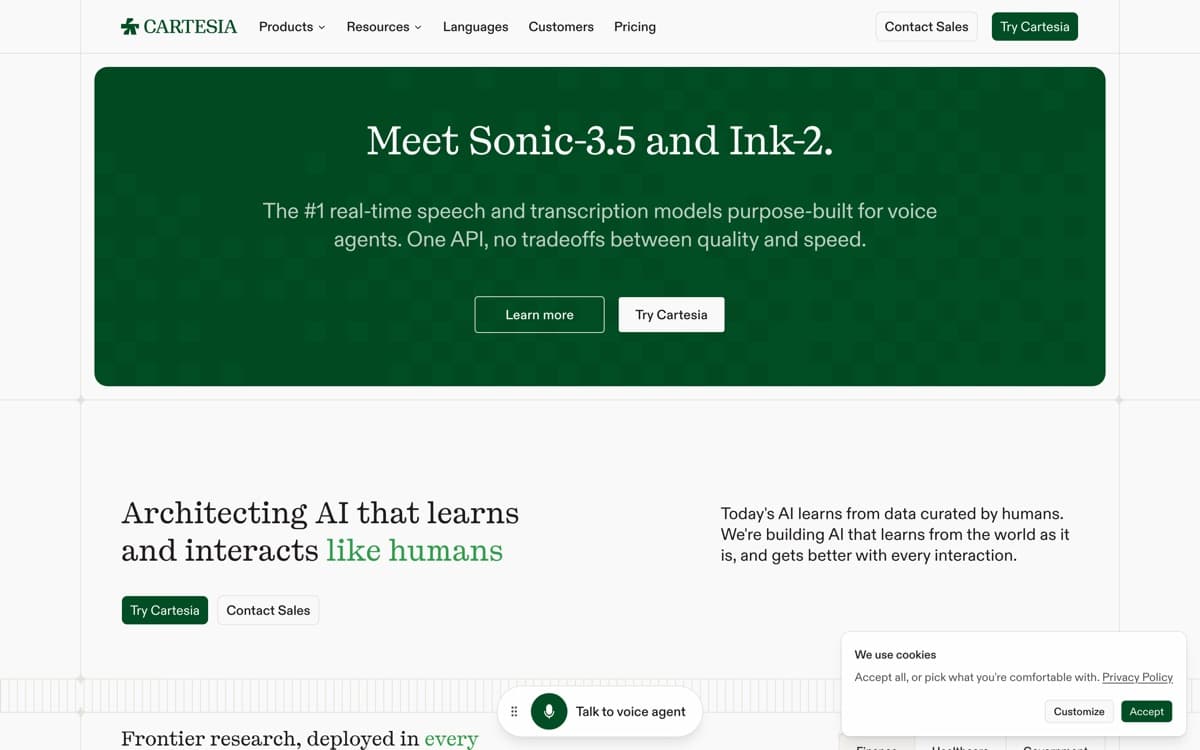
Cartesia builds the voice layer for software that talks back. Founded by the Stanford researchers behind state-space models (the architecture challenging Transformers on speed), its Sonic models start speaking in under 100 milliseconds — fast enough that phone agents interrupt naturally, game characters banter without lag, and translation feels simultaneous. In the voice-agent gold rush of 2025–26, Cartesia became the pick axe. And the speed story is measured, not marketed: its Ink-2 transcription model topped Artificial Analysis's streaming leaderboard in July 2026 at an 8% word-error rate, versus 10% for Deepgram and 12% for ElevenLabs' equivalent.
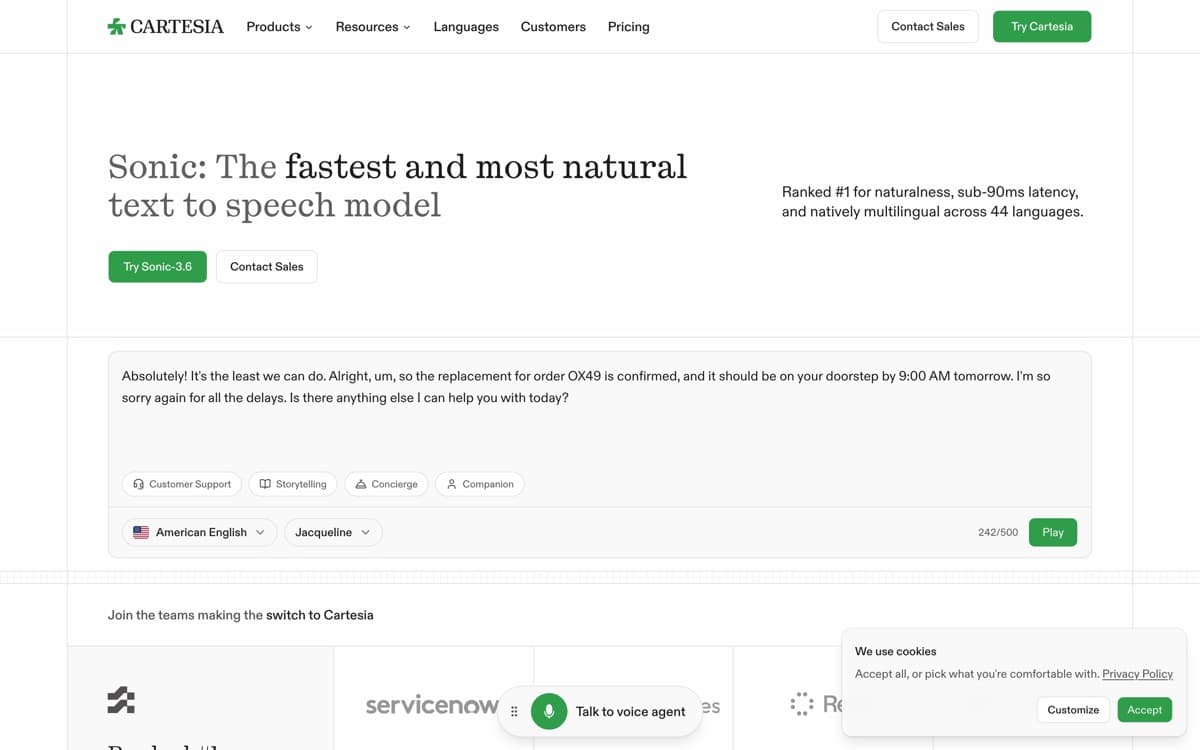
Sonic 3.6 (August 27, 2026) closed the quality gap that used to excuse the speed: natural prosody, laughter, emotional range across 44 languages, with instant cloning from ten seconds of audio. It sits second on Artificial Analysis's voice arena at an Elo of 1275 — behind only ElevenLabs' Eleven v4, released a month later — at about $49 per million characters to v4's $80. On speed the two companies now disagree in public: Cartesia advertises 'sub-90ms latency,' while ElevenLabs' launch tests put Sonic 3.6 at 262 ms to first speech against 150 ms for its own v4 Turbo. Those are different metrics measured by interested parties, and nobody independent has settled it; test both on your own stack. The economics matter as much as the milliseconds — state-space efficiency means high-volume deployments (support lines, NPCs, IVR replacement) run at costs that make per-character premium pricing look quaint, and on-device variants run without a network at all. If you're building rather than producing, this is the modern default.
Cartesia: pros and cons
Pros
- Built for speed — Cartesia claims sub-90 ms latency, though ElevenLabs' v4 Turbo now contests the 'fastest' title
- Sonic 3.6 ranks #2 on Artificial Analysis's blind listening arena, at about 40% less per character than the #1 model
- State-space model architecture runs cheap at scale (and on-device)
- Instant cloning from three seconds of audio
- Clean developer experience: great docs, SDKs, predictable pricing
Cons
- No content-creator suite — it's infrastructure, not a studio
- Voice library and language coverage behind ElevenLabs
- Long-form narration tooling is minimal by design
Standout features
Sub-100ms streaming
Time-to-first-audio low enough for genuinely natural conversation — no awkward beat between question and answer. In voice UX, that beat is everything.
State-space efficiency
The architecture, not just optimization: cheaper inference at scale and credible on-device deployment. High-volume voice products keep margins that Transformer-based pricing eats.
Three-second cloning
Enroll a voice from a snippet and deploy it instantly via API — with consent controls — for personalized agents and localized products.
Cartesia pricing
Free developer credits renew monthly. Paid plans from $5/month scale through creator and pro tiers to volume enterprise contracts; pricing is per character with steep committed-use discounts and on-prem options for regulated deployments.
For conversational products, model total cost per minute of dialogue — Cartesia routinely beats premium rivals by multiples at production scale, which is precisely its wedge.
Our verdict
Cartesia is the developer's answer in a category built for creators: the fastest, most economical real-time voice, now with quality that doesn't apologize. Content producers should stay with ElevenLabs; anyone shipping a product that speaks should benchmark Cartesia first.
Skip it if: You're not writing code. There's no creator studio here and there isn't meant to be — content producers belong two slots up with ElevenLabs or Murf.
4.4 / 5 — #4 in AI Voice Generators 2026
Cartesia: FAQ
Who is Cartesia for?
Developers building voice agents, games, translation, IVR, and companion apps — anything real-time. It's API-first infrastructure, not a content studio.
How fast is Cartesia really?
Cartesia advertises sub-90 ms latency for Sonic 3.6, fast enough for natural conversation. ElevenLabs disputes the 'fastest' claim — its September 2026 tests put its own v4 Turbo ahead — and no independent latency benchmark has settled it, so measure time-to-first-audio in your own application.
Cartesia vs ElevenLabs for voice agents?
ElevenLabs offers a fuller agent platform out of the box; Cartesia wins on latency, unit economics at scale, and on-device options. Many production teams prototype on the former and ship on the latter.
Related rankings: best AI audio tools · best AI video generators · best AI dictation